Federal Court Decides Cross-Motions for Summary J in Wyandotte Nation v. Salazar

Here are the materials:

DCT Order on Cross Motions

Wyandotte Motion for Summary J

Interior Opposition

Kansas Opposition

An excerpt:

Plaintiff Wyandotte Nation, a federally recognized Indian tribe (“the Nation”), filed this lawsuit against Kenneth Salazar, Secretary of the United States Department of the Interior (“the Secretary”), seeking an order from this Court compelling the Secretary to accept title to certain land and hold it in trust for the Nation’s benefit, as specifically required by Public Law 98-602, 98 Stat. 3149 (1984) (“P.L. 98-602”), under both the Administrative Procedure Act (“APA”), 5 U.S.C. § 706(a) and the Mandamus Act, 28 U.S.C. § 1361. The State of Kansas (“the State”) was permitted to intervene as of right under Fed. R. Civ. P. 24(a).1 This matter is before the Court on the Nation’s Motion for Summary Judgment (Doc. 60) and the Secretary and State’s cross-motions for summary judgment (Docs. 66, 69). The Court heard oral arguments on March 14, 2013, at which time the Secretary was directed to supplement the Administrative Record and the matter was taken under advisement. For the reasons explained in detail below, the Court denies the Nation’s motion and grants in part and denies in part the Secretary and the State’s cross- motions, retaining jurisdiction over the case until the agency issues a final decision on the Nation’s pending land-into-trust application.

Prior posts on this case here, here, and here.


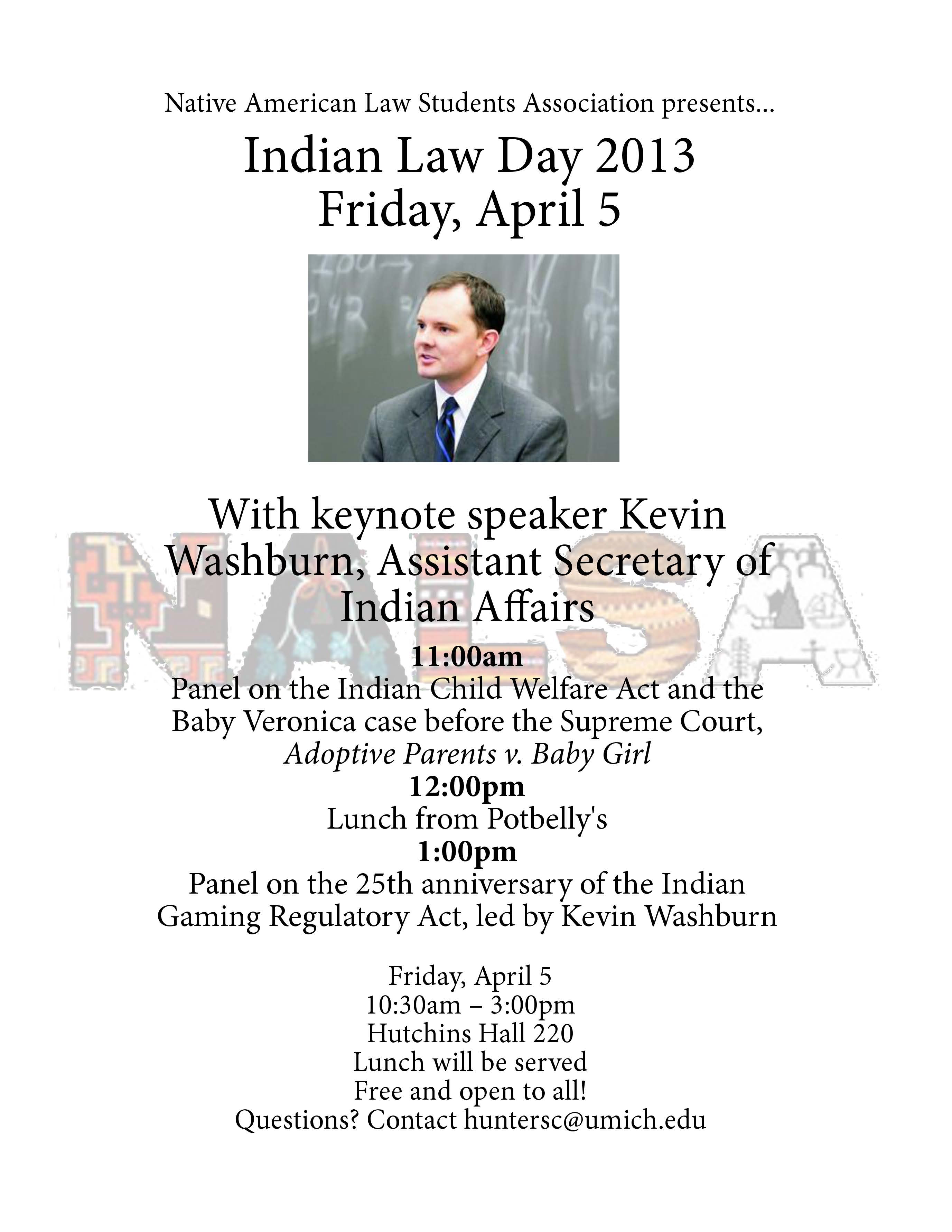
2013 Michigan Indian Law Day — This Friday — UM Law School

ILD2-1

Here:

ILD2-1

Pauma Band Largely Prevails in Gaming Compact Suit against California

Here are the materials in Pauma Band of Luiseno Mission Indians of the Pauma & Yuima Reservation v. State of California (S.D. Cal.):

Pauma DCT Order

Pauma Motion for Summary J

California Opposition

Pauma Reply

California Cross-Motion

Pauma Opposition

California Reply

California COA Briefs in Sharp Image Gaming v. Shingle Springs Miwok

Interesting and important case. The appeal is from a $30 million judgment against the Shingle Springs Band of Miwok Indians in favor of a developer of a gaming facility that failed in the 1990s, before the Tribe partnered with a new developer and spent hundreds of millions of dollars to open the existing Red Hawk Casino. The case went to trial after the NIGC’s final agency action ruling the main contract at issue was void as an unapproved management agreement.

2012-10-10 Tribe’s Opening Brief

2012-11-26 Sharp’s Respondent’s Brief

2013-02-15 Tribes Reply Brief

From the Tribe’s Opening Brief:

[T]he Superior Court erred in assuming subject matter jurisdiction over this breach of contract lawsuit by purporting to overturn a federal agency’s binding determination that the contract was unenforceable under a preemptive federal statute. It was also error to assume jurisdiction over a sovereign Indian nation after finding the Tribe did not clearly and unequivocally waive its immunity.

. . .

Once the NIGC took final agency action ruling Sharp’s ELA was a management contract that was void for lack of agency approval, this case was effectively over—or at least it should have been. The decision of the NIGC, the federal agency charged with approving and disapproving management contracts under IGRA, is binding on lower courts unless successfully challenged in a United States District Court. AT&T, 295 F.3d 899, 906, 909-10. Sharp opposed the Tribe’s efforts to stay the Superior Court action to permit Sharp to initiate proceedings in the only proper forum: federal district court. . . . Instead, Sharp convinced the Superior Court to reach the merits of the NIGC’s decision and enforce the very revenue sharing provisions the NIGC deemed illegal. . . . Sharp’s election to proceed without first challenging the NIGC’s final agency action is dispositive of the viability of Sharp’s ELA: it is void unless and until Sharp brings a proper federal court challenge, and any claims predicated on the ELA’s validity fail as a matter of law.

. . .

The Superior Court erred by failing to dismiss this case on mandated federal sovereign immunity principles. In ruling on the Tribe’s jurisdictional motion to dismiss, the Court erroneously applied inapposite state law contract interpretation cases when the question is controlled by federal law. . . . The Court also erred, as a matter of law, by failing to treat the defense as a question that needed to be resolved at the outset of the case, as opposed to one appropriate for a jury. . . . Finally, the Superior Court erred when it issued a ruling that should have compelled dismissal, since it found that the Tribe’s reading of the waiver provision in Sharp’s contracts was “reasonable” given the evidence regarding the waiver’s actual scope—i.e., that the waiver of immunity did not reach Sharp’s claims, and was limited to the gaming facility that Sharp and the Tribe had partnered to build, Crystal Mountain Casino.
Two New Papers by Alex Skibine on IGRA and Indian Country Hot Pursuit

The Indian Gaming Regulatory Act at 25: Successes, Shortcomings, and Dilemmas
Alexander Tallchief Skibine
University of Utah – S.J. Quinney College of Law
Date Posted: January 14, 2013
Working Paper Series

Hot Pursuit into Indian Country: What Are the Limits?
Alexander Tallchief Skibine
University of Utah – S.J. Quinney College of Law
Date Posted: January 14, 2013
Working Paper Series

United Auburn Indian Community v. Salazar Complaint re: Trust Acquisition for Enterprise Rancheria of Maidu Indians of California

Here is the complaint:

UAIC v Salazar Complaint

Second Update in Michigan’s Suit against Proposed Sault Tribe Lansing Casino

Here are the new materials in State of Michigan v. Sault Ste. Marie Tribe of Chippewa Indians (W.D. Mich.):

Michigan Reply in Support of Motion for PI

Michigan Response to SSM Motion to Dismiss

Nottawaseppi Huron Band of Potawatomi Indians filings:

2012-12-21 Amicus Brief with Exs.

2012-12-21 Memorandum in supportof Motion to file an amicus brief

2012-12-21 Motion to file an amicus brief

Saginaw Chippewa Indian Tribe filings:

motionforleavetofile&brief

sagchipamicus

exhibitssagchip

Previous materials are here (complaint and motion for PI) and here (Sault Tribe’s responsive pleadings).

Update in Michigan’s Suit against Sault Tribe and Lansing Casino Proposal

The tribe has moved to dismiss and to oppose the State’s request for a preliminary injunction.

Sault Tribe Motion to Dismiss

Sault Tribe Response to Motion for PI

The complaint is here.

News coverage is here.

Available Briefs in Second Circuit Appeal of Constitutional Challenge to IGRA and Seneca Compacts

Here are the appellee briefs in Warren v. United States:

Brief for Federal Appellees

Brief for New York Appellees

Brief for Seneca Nation Amicus

Lower court materials here.

Split Ninth Circuit Panel Affirms Gila River Indian Community v. United States

Here is today’s opinion.

An excerpt:

This case illustrates the nuances of our federalist system of government, pitting Indian tribe against Indian tribe, and State and local governments against the federal government and an Indian tribe. The City of Glendale and various other parties (“Glendale”) seek to set aside the Department of the Interior’s decision to accept in trust, for the benefit of the Tohono O’odham Nation (“the Nation”), a 54-acre parcel of land known as Parcel 2. The Nation hopes to build a destination resort and casino on Parcel 2, which is unincorporated county land, entirely surrounded by the City of Glendale. To say this plan has been controversial is an understatement. But the strong feelings and emotional drama of the casino fight do not dictate the outcome here. This appeal relates only to the status of the land as trust land and does not involve the particulars of Indian gaming, which are the subject of separate proceedings and pending legislation. The district court granted summary judgment for the government after concluding that the Secretary of the Interior reasonably applied the Gila Bend Indian Reservation Lands Replacement Act (“Gila Bend Act”), and that the Act did not violate the Indian Commerce Clause or the Tenth Amendment. We affirm.

Briefs here.

Lower court materials here.