Here:
bmic-letter-to-gov.-whitmer-line-5-future-5-10-19.pdf
Here are the updated pleadings in Little Traverse Bay Bands of Odawa Indians v. Whitmer (W.D. Mich.):
568 Municipal Defendants Motion for Summary Judgment
572 Governor Motion to Dismiss on Jurisdiction
582 Governor Motion for Summary Judgment
583 LTBB Motion for Partial Summary Judgment re Intervenors
586 LTBB Motion for Summary Judgment — Historical
591 Intervenors Response to 583
603 Municipal Defs Response to 586
608 Municipal Defs Response to 583
610 – Tribe’s Resp. in Opp. to Municipal Def. Motion for SJ
611 – Tribe’s Resp. Brief in Opp. to State’s Motion for SJ
Here are the materials on remand from the Sixth Circuit in Saginaw Chippewa Indian Tribe v. Blue Cross Blue Shield (E.D. Mich.):
Prior posts here.
Sad news.
Here.
There is a Michigan Indian angle here, in that the famed Keith case involved a Michigan Indian as the defendant in the wiretapping matter. Add here also.
Here are the materials so far in Sault Ste. Marie Tribe of Chippewa Indians v. Bernhardt (D.D.C.):
1-1 Solicitor Opinion on Bay Mills
1-6 July 2017 Interior Decision
16-1 Saginaw Chippewa Motion to Intervene
18-1 Detroit Casinos Motion to Intervene
20 Nottawaseppi Huron Band Motion to Intervene
28 Sault Tribe Opposition to Intervention Motions
29 Federal Opposition to Detroit Casinos Motion to Intervene
31 Saginaw Chippewa Reply in Support of 16
32 Detroit Casinos Reply in Support of Motion to Intervene
33 NHBPI Reply in Support of Motion to Intervene
Prior posts on the Lansing/Wayne County casino proposals are here.
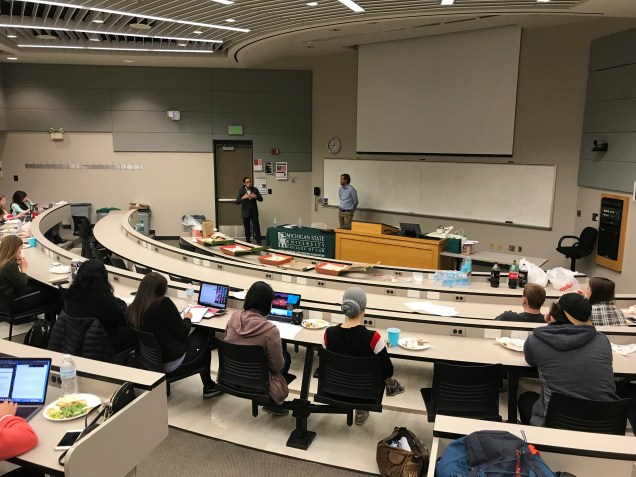
I am delighted to be presenting a keynote speech titled “Race, Politics, and the Constitution” today for the National Council of Urban Indian Health (PR here). Francys Crevier (PLSI 2010), my former student, is the Executive Director of the organization.
My talk will take the theme of my forthcoming paper “Politics, Indian Law, and the Constitution” and apply those principles to demonstrate that the Indian Health Service owes a trust duty to urban Indians and related matters.
Those who know me best know Turtle Talk was inspired by the newsletter put out by the Grand Rapids Inter-Tribal Council. My mother worked there when I was a Benodjehn.
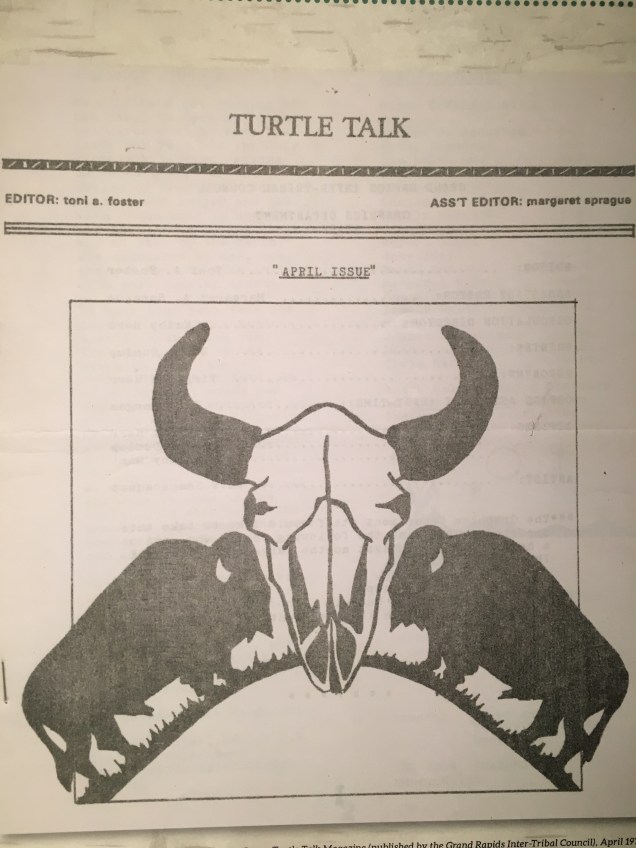
Here (PDF):
Forthcoming in the Montana Law Review’s Browning Symposium issue, available at SSRN here.
An excerpt:
Many of my first memories revolve around my grandmother Laura Mamagona’s apartment in Grand Rapids, Michigan. She shared the apartment with my uncle Crockett, who was a college student. Her apartment was the upstairs room of an old house on the side of a hill on College Street. My memories are mostly of domestic activities. Cooking. Sweeping. Sitting around. Playing with trains. Leafing through Crockett’s Sports Illustrated magazine collection. Laura worked the night shift at the veteran’s hospital across from Riverside Park. Early on weekday mornings, June, my mother, would drop me off at Laura’s place in her VW bug, the first car I remember. I had my own crib at Laura’s, one I can remember escaping pretty easily. Often, Laura would sleep most of the morning while I puttered around the house. Sometimes, Crockett would be there. Family lore tells that once, June dropped me off earlier than usual and Laura had worked a little late, so I was probably there alone for a short while. I heard the story so often growing up that I can seemingly remember that day, too. This was in the mid-1970s, before Congress enacted the Indian Child Welfare Act.
Recently, my wife Wenona Singel discovered documents about Laura’s childhood home life in the National Archives in Chicago. Wenona was there to research family boarding school histories. Laura’s name as a young woman, Laura Stevens, was listed alongside several of her brothers and sisters as former students at Mount Pleasant Indian Industrial Boarding School. They were all born with the Pokagon surname, but Laura’s dad, Peter Stevens, changed their names, thinking it would help the family blend in with white America. Laura never attended the boarding school, and instead spent those years in quarantine in a hospital in Kalamazoo. We think she tested positive for tuberculosis at the boarding school intake and was diverted to quarantine. While Laura was there in the hospital during several of her early teen years, her biological mother walked on. Laura had younger brothers and sisters in her family home in Allegan County, Michigan. So, Peter—who was single then—drove to Kalamazoo and took Laura home. As a young woman, but the oldest sibling left in the house, Laura was forced to replace her mom. The archive documents contain reports by social workers who visited the house, we think, on somewhat random occasions. They were spot checks, of sorts, by the State of Michigan, to see how this Indian family with no mother in the home was coming along. The social workers detailed every aspect of the Stevens’ home in the reports. They noted how many Bibles were in the house and where they were placed. They noted how many portraits of Jesus Christ there were and the location each was hung. They reported Laura’s younger siblings were all dressed for company and quietly studying. They focused especially on teenaged Laura. There she was, sweeping the kitchen. There she was, cooking dinner. There she was, folding clothes. The social workers were impressed. Well, they were barely impressed. Laura was, after all, still an Indian. Reading the reports, one can’t help but think that young Laura Stevens was the only thing stopping the State from taking Peter Stevens’s kids away from him. Imagine if she had been out shopping on the day of the spot visit. The little Stevens kids would have been home alone, dishes in the sink and dirty clothes on the floor. Laura might have come home from shopping, and then later Peter from work, to find a home stripped of its children. However, this never came to be. Perhaps out of sheer luck, Laura was always home when the social workers showed up.
And:
The Fifth Amendment of the United States Constitution is a truly fateful provision for Indian people. On occasion, Wenona and I teach at the Pre-Law Summer Institute (PLSI) for American Indians. It’s an eight week program that serves a little bit like a summer boot camp for Indian people who are planning to matriculate to law schools in the fall. Wenona teaches Property and I teach Indian Law. Compared with the regular law school survey-the-field course in Federal Indian Law, the short class I teach at PLSI is even more truncated. I can only assign a cross-section of the “greatest hits” of Indian law Supreme Court decisions because I don’t have time to conduct a full survey. I also try to assign cases where tribal interests prevailed. It turns out tribal interests and Indian people prevail more than not when the Fifth Amendment is in play. However, there are cases where tribal interests painfully and dramatically suffer under the Supreme Court’s interpretation of the Fifth Amendment.
CORA, GTB, and Bay Mills comments on EPA’s proposal to change the definition of “Waters of the United States.”
Doug Craven (LTBB) and Trevor VanDyke (Mich. DNR) — The Intersections Between Conservation Law & Indigenous Law
 Turtle Talk
You must be logged in to post a comment.