Navajo Nation DOJ Job Posting

A little delayed. Sorry!

ATTORNEY POSITIONS
NAVAJO NATION DEPARTMENT OF JUSTICE
JUNE 19, 2014

The Navajo Nation Department of Justice is seeking several energetic and motivated attorneys to work in the areas of tax, finance, tribal government, social services, and natural resources.

For a complete list of available positions, please see http://www.dpm.navajo-nsn.gov/jobs.html.

Applicants must be actively licensed with any state. Thereafter, attorneys hired by the Department are required to obtain licensure in the Navajo Nation as well as one of the following states: Arizona, New Mexico or Utah.

Please direct applicant packets consisting of (1) Letter of Interest with current address, telephone numbers, and e-mail address; (2) Navajo Nation employment application; (3) resume; (4) recent legal writing sample; (5) copy of bar membership certificates; and (6) law school graduation documents to Navajo Nation Department of Justice, Attention: Dana Bobroff, Deputy Attorney General, Office of the Attorney General, P.O. Box 2010, Window Rock, AZ 86515, and to the Navajo Nation Department of Personnel Management, P.O. Box 7080, Window Rock, Arizona, 86515.

Please visit http://www.dpm.navajo-nsn.gov/apply.html to obtain a copy of the Navajo Nation employment application. For any questions, please contact Dana Bobroff at 928/871-6345.

The Navajo Nation Department of Justice complies with the Navajo Preference in Employment Act.
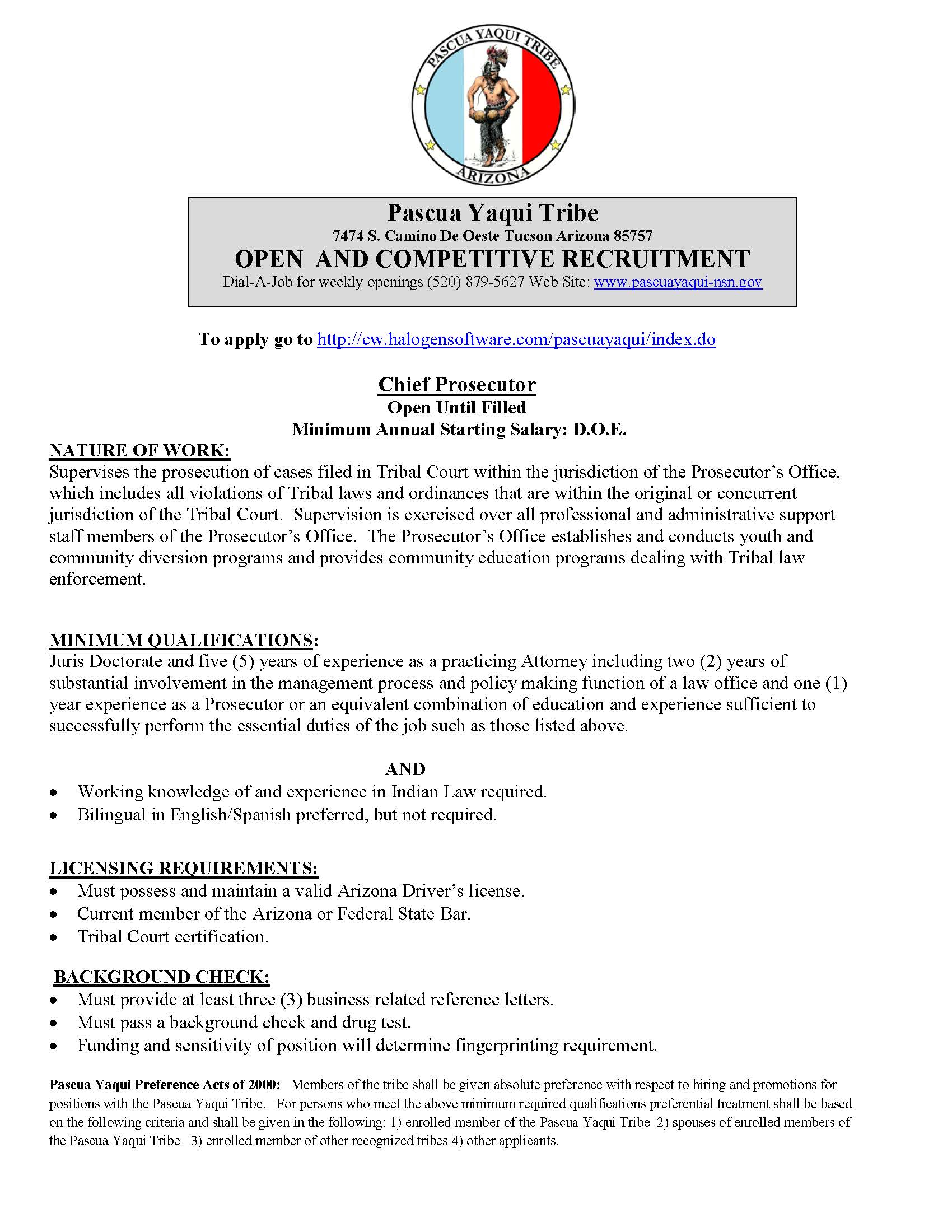
Pascua Yaqui Chief Prosecutor Position Open

Here (PDF):

Chief Prosecutor Announcement

Federal Court Finds Jurisdiction in Tribal Dispute with Massachusetts over Regulation of Gaming on Martha Vineyard

Here are the materials so far in Commonwealth of Massachusetts v. Wampanoag Tribe of Gay Head (Aquinnah) (D. Mass.):

1 Notice of Removal

18 Massachusetts Motion to Remand

21 Opposition to Motion to Remand

25-1 Massachusetts Reply

31 DCT Order

An excerpt:

This lawsuit involves a dispute between the Commonwealth of Massachusetts and a federally recognized Indian tribe as to who has regulatory jurisdiction over civil gaming on Indian lands on Martha’s Vineyard. The Aquinnah Wampanoag Tribe and related entities have taken steps to commence commercial gaming operations on tribal lands without a license from the Commonwealth. The Commonwealth of Massachusetts contends that by doing so, the Tribe violated a 1983 settlement agreement that subject the lands in question to state civil and criminal jurisdiction. Count 1 of the complaint alleges breach of contract, and Count 2 seeks a declaratory judgment.

The Commonwealth filed suit in state court on December 2, 2013. On December 30, 2013, defendants removed the action to this Court on the basis of federal-question and supplemental jurisdiction, 28 U.S.C. §§ 1331, 1367. The Commonwealth has moved to remand the matter to state court. For the reasons set forth below, the motion will be denied.

Navajo Nation Wins Multi-Million Dollar Judgment against HUD

Here are the orders in Navajo Nation v. United States Department of Housing and Urban Development  (D. Colo.):

72 DCT Order on Liability

82 DCT Damages Order

Selected Materials from Alaska Native Voting Rights Trial

Here are materials from Toyukak v. Treadwell (D. Alaska):

47 Alaska Motion for Partial Summary J

74 Plaintiffs Response to 47

86 Alaska Reply in Support of 47

128 Alaska Objection to McCool

138 Alaska Trial Brief

140 Plaintiffs Trial Brief

146 Plaintiffs Response to 128

News coverage here and here. H/t Pechanga.

TransCanada’s South Dakota Public Utilities Commission Permit to Build KeystoneXL Expires

Here, “With one more nail in its coffin, is Keystone XL history?”

IBIA Affirms Trust Land Acquisition for St. Regis Mohawk over Carcieri Challenges

Here is the opinion in State of New York v. Acting Eastern Regional Director, Bureau of Indian Affairs:

58ibia323

H/T Pechanga.


ALJ Applies NLRA to Pauma Band of Mission Indians’ Casino

Here is the opinion in Casino Pauma and Unite HERE International Union:

Administrative Law Judges Decision

H/T Pechanga.

More Filings in California v. Paskenta Band

Here are additional filings in State of California v. Paskenta Band of Nomlaki Indians (E.D. Cal.):

22 – Paskenta Band of Nomlaki Indians’ Third Party Complaint

23 – Paskenta Band of Nomlaki Indians’ Supplemental Briefing in Support of Enjoining Class II Gaming Activity

23-1 – Second Declaration of Vice Chairman David Swearinger

24 – Plaintiff’s Request for Preliminary Injunction and Opposition to Enjoining Class II Gaming Activity

26 – Opposition to Supplemental Brief Regarding Expansion of Existing Injunctive Relief

26-1 – Declaration of Andrew Freeman Re Opposition to Supplemental Brief Regarding Expansion of Existing Injunctive Relief

26-2 – Declaration of Bob Cloud Re Opposition to Supplemental Brief Regarding Expansion of Existing Injunctive Relief

Prior posts here and here.


Angela Riley: “Native American Lands and the Supreme Court”

Angela Riley has posted her very impressive paper, “Native American Lands and the Supreme Court,” published in the Journal of Supreme Court History, on SSRN.

Here is the abstract:

The Supreme Court has been instrumental in defining legal rights and obligations pertaining to Indian lands since its first path-making decision in the field in Johnson v. McIntosh in 1823. But the groundwork for the Court’s contemplation of such cases predates Supreme Court jurisprudence, and it in fact predates the formation of the Court and the United States itself.

When Europeans first made contact with this continent, they encountered hundreds of indigenous, sovereign nations representing enormous diversity in terms of language, culture, religion, and governance. For those indigenous groups — as is a common attribute of indignity of similarly situated indigenous groups around the world — this land was and is holy land. Indigenous creation stories root Indian people in this continent — Turtle Island to many — as the focal point of life, creation, religion, culture, and language. In the settlement of the country, the colonial powers initially — and the United States subsequently — treated with Indian nations to negotiate the transfer of lands from Indians to Europeans, often in exchange for peace or protection.

Prof. Riley had previously presented this paper to the Supreme Court historical society, which was televised on C-SPAN.