Here are the materials in Martin v. Quapaw Tribe (N.D. Okla.):
Author: Matthew L.M. Fletcher
Federal Dismisses FTCA Claims against US in Shooting of Tribal Member by Tribal Police
Here are the materials so far in Black v. United States (W.D. Wash.):
23 Port Gamble S’Klallam Response
31 DCT Order Dismissing Complaint
Claims against Suquamish and Port Gamble S’Klallam Tribes and officers remain.
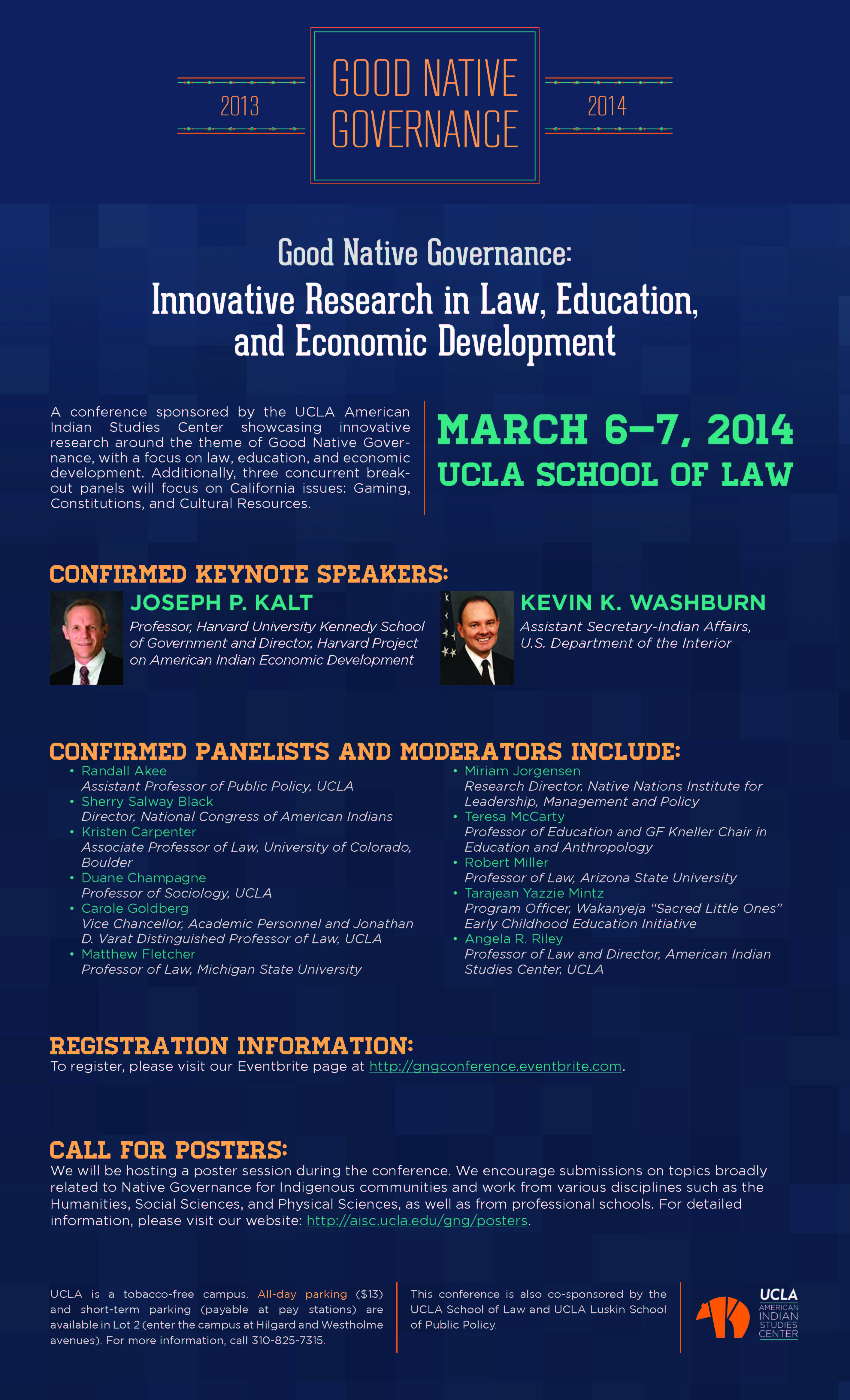
UCLA Good Native Governance Conference Flyer
Here (PDF):
New Scholarship on Carcieri, Patchak, and the HEARTH Act Regulations
Noah Nehemiah Gillespie has published “Preserving Trust: Overruling Carcieri and Patchak While Respecting the Takings Clause” (PDF) in the George Washington Law Review.
Here is the abstract:
The potential benefit of new Bureau of Indian Affairs (“BIA”) regulations for development on Native land has been overshadowed by two recent Supreme Court decisions—Carcieri v. Salazar and Match-E-Be-Nash-She- Wish Band of Pottawatomi Indians v. Patchak—which cast doubt on the title to Native land and dramatically expand the rights of nearby owners to sue by challenging Native use of that land under the Administrative Procedure Act (“APA”). Legislation that would amend the statutes the Court interpreted in Carcieri and Patchak could remedy these ill effects but would pose a new problem: the taking of a vested cause of action without just compensation.
This Essay proposes that Congress enact appropriate legislation that both overrules the Court’s interpretations of the relevant statutes and permits takings suits in place of suits under the APA, so that Native land remains securely under Native control. In addition, the BIA must harness the agency deference it deserves to set Native sovereignty at the center of federal Indian policy.
NNABA Press Release on Diane Humetewa Nomination
For Immediate Release, September 19, 2013
Contact: Mary L. Smith (202) 236-0339
NNABA APPLAUDS THE HISTORIC NOMINATION OF
DIANE HUMETEWA TO BE A FEDERAL JUDGE IN ARIZONA
Phoenix, AZ. – The National Native American Bar Association applauds the historic nomination of Diane Humetewa to be a district court judge for the U.S. District Court for the District of Arizona. If confirmed, Ms. Humetewa will be the first Native American woman in the history of our nation to serve on the federal judiciary.
Ms. Humetewa has had a distinguished career in public service. She is an enrolled member of the Hopi Tribe. She previously served as the Senate-confirmed U.S. Attorney for the District of Arizona. Earlier in her career, she worked as an attorney on the U.S. Senate Indian Affairs Committee under then Chairman John McCain. Ms. Humetewa also worked in the U.S. Department of Justice and served as an Appellate Judge on the Hopi Appellate Court.
“NNNABA applauds President Obama for the historic nomination of Diane Humetewa to the federal bench in Arizona. Ms. Humetewa’s stellar career,including her position as a federal prosecutor, will serve her well as the first female Native American ever appointed to the federal judiciary and the only American Indian in the federal judiciary,” said Mary Smith, NNABA President.
Founded in 1973, NNABA serves as the national association for American Indian, Alaska Native, and Native Hawaiian attorneys, judges, law professors and law students. NNABA strives for justice and effective legal representation for all American indigenous peoples; fosters the development of Native American lawyers and judges; and addresses social, cultural and legal issues affecting American Indians, Alaska Natives, and Native Hawaiians.
For more information contact 480-727-0420 or visit http://www.nativeamericanbar.org.
House Resources Subcommittee Hearing on Federal Trust Acquisitions for Gaming Purposes
Here:
Oversight Hearing on:
- “Executive Branch standards for land-in-trust decisions for gaming purposes”
Member Statements:
The Honorable Don Young
Subcommittee Chairman
Witnesses and Testimony:
PANEL I
Kevin Washburn
Assistant Secretary for Indian Affairs
U.S. Department of the Interior
PANEL II
The Honorable Todd Mielke
County Commissioner
County of Spokane
Hazel Longmire
Vice-Chairperson
Colusa Indian Community Council
Alexander Skibine
Professor
University of Utah
Ninth Circuit Issues Amended Opinion in Zepeda — Same Outcome, Different Reasoning
Here are the new materials:
Zepeda Response to En Banc Petition
From Judge Watford’s now-much-shortened dissent:
I agree with much of the majority’s analysis, particularly its conclusion that whether a tribe has been recognized by the federal government is a question of law. But I disagree with the majority’s ultimate determination that the government failed to present sufficient evidence from which a rational jury could infer that Zepeda has a blood connection to a federally recognized tribe. Under Jackson v. Virginia, 443 U.S. 307, 319 (1979), a rational jury could certainly infer that the reference in Zepeda’s tribal enrollment certificate to “1/4 Tohono O’Odham” is a reference to the federally recognized Tohono O’odham Nation of Arizona.
Panel materials are here.
Materials on affected appeals are here.
Montana SCT Asserts Jurisdiction over “Ojibwe Peace Flag” Probate
Here are the materials in Estate of Gopher:
An excerpt:
In its order, the Blackfeet Tribal Court unequivocally declined to assert subject matter jurisdiction with respect to the flag, the subject of this appeal. The Blackfeet Tribal Court noted that the “flag is located in Cascade County and has never been on the Blackfeet reservation” and Dorothy was domiciled in Cascade County at the time of her death. The Blackfeet Tribal Court stated it “will not accept any further filings from the Gopher family in regards to the thirteen star flag until they have prevailed in their litigation in the State Court.” No evidence supports the siblings’ argument that the Blackfeet Tribal Court’s decision was made “prematurely or through error.” Because the Blackfeet Tribal Court has expressly declined to assert jurisdiction over the Estate property, it is clear that the District Court did not unlawfully infringe on the Blackfeet Tribe’s right of tribal self-government. Moreover, because Dorothy resided in Cascade County at the time of her death and the corpus of the Estate is located in Cascade County, venue was proper, and the District Court did not err when it assumed jurisdiction over the probate of the Estate.
Quapaw Tribe Congressional Reference Case Survives Motion to Dismiss
Here are the materials in Quapaw Tribe v. United States (Fed. Cl.):
Tenth Circuit Rejects Uinta Allottees Petition for Section 17 Corporate Charter
Here are the materials in Gardner v. Jewell:


You must be logged in to post a comment.