Here:
Question presented:
Whether a state may exercise criminal jurisdiction over an Indian for conduct in Indian country absent a valid congressional grant of authority.

Lower court materials here.
Here:
Question presented:
Whether a state may exercise criminal jurisdiction over an Indian for conduct in Indian country absent a valid congressional grant of authority.
Lower court materials here.
Erica Liu has published “The Cartographic Court” in the NYU Law Review.
Here is the abstract:
Over the past few decades, the Supreme Court of the United States has adopted an exceedingly narrow view of tribal civil jurisdiction, establishing doctrines that restrict the circumstances in which Native Nations can exercise their regulatory and adjudicative powers. While most scholarship in federal Indian law has assessed this judicial trend towards tribal disempowerment by focusing on the Court’s treatment of tribal sovereignty, this Note centers the Court’s manipulation of tribal territory. It argues that the Court has constructed three territorial incongruities—non-Indian fee lands, public access, and loss of “Indian” character—to justify the disallowance of tribal authority over significant portions of tribal reservations. In so doing, the Court relies on a spatial imaginary of territorial sovereignty, or the notion that sovereign power must be commensurate with sovereign domain, to present certain spaces as falling outside of a Native Nation’s territory and, accordingly, as beyond the reach of its jurisdictional power.
By illuminating the spatial imagination of the Supreme Court, this Note identifies a key practice employed by the Court that is central to empires past and present— cartography. The Court superimposes its own imagined legal geography upon the preexisting system of territorial division, redrawing the jurisdictional boundaries that separate states and Native Nations. This practice of spatial manipulation is cartographic in that it allows the Court to determine and limit the territory of tribal rule; to expand the areal authority of state jurisdiction; and to project its particular vision of reservation lands—a vision defined by notions of ownership, accessibility, and character—upon Indian country. These cartographic tactics of territorial acquisition and control are in direct furtherance of the American colonial project. They fragment tribal regulatory regimes, reify Indigenous life, and transfer congressional power to the Court to diminish tribal reservations. These practices of fragmentation, reification, and de facto diminishment are continuations of the repudiated but never-undone federal policy of allotment, although the main perpetrator is now the Court rather than Congress.
By turning to critical legal geography and theories of space and power, this Note reveals a Supreme Court that is highly imaginative, overtly spatial, and problematically cartographic in nature, engaged in a project of colonial expansion across its tribal civil jurisdiction cases.
Gregory Ablavsky has published “Structural Federal Indian Law after Brackeen” in the Arizona Law Review. PDF
The abstract:
“You know, when it comes to Indian law, most of the time we’re just making it up,” Justice Scalia once observed. This admission echoed long-standing critiques of the Supreme Court’s jurisprudence in the field, but these anxieties did not trouble the Court—until recently. Over the past two decades, the Court has begun to revisit the field’s foundations, culminating in the Court’s 2023 decision in Haaland v. Brackeen, which upheld the Indian Child Welfare Act against a constitutional challenge. Though the Court upheld the law, the majority pleaded for a “theory for rationalizing this body of law.” Justices Gorsuch and Thomas, each writing separately and at length, offered sharply different visions that would dramatically remake current doctrine.
Rather than providing a single theory, this Article tries to make sense of this current moment of “confusion” in federal Indian law, in the Brackeen majority’s language, by putting the field in dialogue with structural constitutional law. The fields have much in common: both deal with legal rules governing the distribution of governmental authority, and both confront the frequent absence of textual guidance. But in structural constitutional law—which rarely considers the authority of Native nations—the Court has developed a clearer and more fully articulated methodology for resolving this problem of textual underdetermination.
Extending this approach to federal Indian law, I argue, could produce greater clarity and rigor in the field. In particular, this method yields what I term two answers that the federal government has posited over its history to the interrelated questions of federal, Native, and state authority. I then use this framework to evaluate the visions for federal Indian law announced in Brackeen, all of which elide or submerge the jurisprudential choices that assessing these conflicting answers requires. I conclude by offering some thoughts on how Native nations and their advocates might confront this current moment of uncertainty and debate within the Court’s Indian law jurisprudence.
Here:
Questions presented:
Whether the District Court violated Petitioners’ due process rights by granting summary judgment without first fulfilling its gatekeeping obligation under Daubert v. Merrell Dow Pharmaceuticals, Inc., 509 U.S. 579 (1993), to rule on the parties’ pending motions to exclude or limit expert testimony?
Whether the District Court erred by relying on the Respondents’ expert witness in its summary judgment decision without first addressing the Petitioners’ motion to exclude or limit Respondents’ expert’s testimony under Daubert?
Whether the District Court violated Petitioners’ due process rights by failing to conduct an in camera review of 4,780 documents withheld by Respondents under claims of privilege, despite having ordered such a review and having possession of the documents since May 2019?
Whether the Court improperly analyzed the Andros Treaty by not finding the Treaty ambiguous and conducting the Indian Canons analysis?
Whether the Court misapprehended the law in finding the Andros Treaty not valid under Federal law?
Lower court materials here.

Here is today’s order list, with the dissent beginning on page 6.
An excerpt:
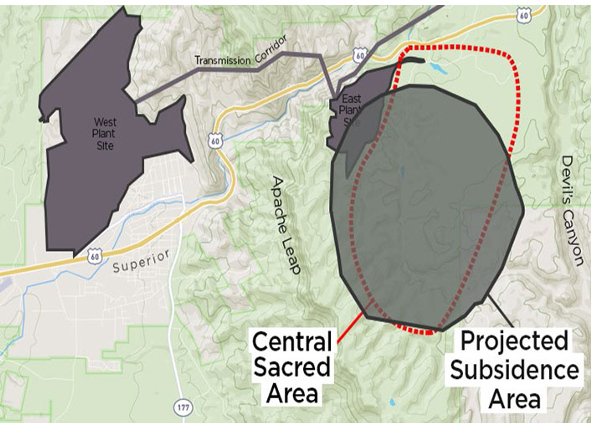
While this Court enjoys the power to choose which cases it will hear, its decision to shuffle this case off our docket without a full airing is a grievous mistake—one with consequences that threaten to reverberate for generations. Just imagine if the government sought to demolish a historic cathedral on so questionable a chain of legal reasoning. I have no doubt that we would find that case worth our time. Faced with the government’s plan to destroy an ancient site of tribal worship, we owe the Apaches no less. They may live far from Washington, D. C., and their history and religious practices may be unfamiliar to many. But that should make no difference. “Popular religious views are easy enough to defend. It is in protecting unpopular religious beliefs that we prove this country’s commitment to . . . religious freedom.” Masterpiece Cakeshop, Ltd. v. Colorado Civil Rights Comm’n, 584 U. S. 617, 649 (2018) (GORSUCH, J., concurring).
Prior posts here,
The denied petitions are Lexington Ins. Co. v. Suquamish Tribe and Lexington Ins. Co. v. Mueller.
Here:
Questions presented:
Whether Rule 19 requires dismissal of APA suits challenging federal agency action whenever a nonparty who benefited from that action asserts sovereign immunity.

Lower court materials here.
Here are the materials in Apache Stronghold v. United States (D. Ariz.):

 Turtle Talk
You must be logged in to post a comment.