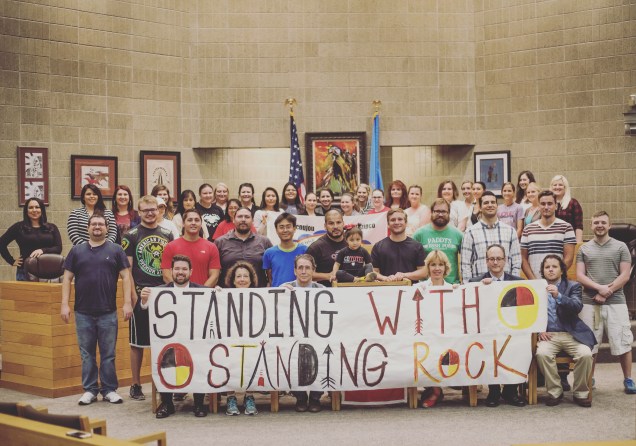
Skokomish Sues Suquamish Tribal Council Members over Treaty Fishing

Here is the complaint in Skokomish Indian Tribe v. Forsman (W.D. Wash.):

1 Complaint

Nez Perce Files Suit Over Final Decision in Clear Creek Project

Download complaint here.

Link to news coverage here.

Superior Court Finds Upper Skagit Tribe Necessary Party in Declaratory Action

Download Court’s letter opinion in re: Schuyler v. Unsworth & Dept. of Fish and Wildlife, Thurston County Cause No. 14-2-02373-9 here.

A member of the Upper Skagit Tribe filed an action in Superior Court for declaratory relief on certain tribal hunting and fishing rights guaranteed by the Treaty of Point Elliot.  However, the Court held that the case affects the rights of the Tribe and therefore the case must be dismissed if it cannot be joined within 90 days.

The 9th Circuit has affirmed the Culverts decision & the treaty habitat right in W. Wash.

Download opinion in U.S. v. Washington (9th Cir. Jun 27, 2016) here.

The decision is unanimous. Congratulations to all who worked on it through the years and first and foremost to the Tribes who brought it.

Previous coverage and briefs here.

Cert Petition in Trust Accounting Claim for Sand Creek Descendants

Download petition for a Writ of Certiorari here.

Questions presented:

Whether a treaty promise to pay reparations to a group of Native Americans in the form and amount that is “best adapted to the respected wants and conditions of” said group of Native Americans, and subsequent appropriation of funds by Congress to pay such reparations, create a fiduciary relationship between the United States and said group of Native Americans.

Whether the Administrative Procedures Act waives the United States’ immunity from suit for accounting claims regarding trust mismanagement that begun before the enactment of the Act.

Whether a set of Appropriations Acts by Congress that defer the accrual of trust mismanagement claims against the United States operates as a waiver of the United States’ immunity from suit.

Previous posts in re Flute v. U.S. here.

Army Corps of Engineers Rejects Gateway Pacific Terminal

Download Memorandum for Record here.

The Corps has denied the permit to build a coal export facility near Cherry Point after deciding the impact to Lummi Nation fishing would violate their treaty rights.

Fletcher & Singel on the Historical Basis for the Trust Relationship between the US and Indian Children

Fletcher & Singel have posted “Indian Children and the Federal Tribal Trust Relationship” on SSRN.

Here is the abstract:

This article develops the history of the role of Indian children in the formation of the federal-tribal trust relationship and comes as constitutional challenges to the Indian Child Welfare Act (ICWA) are now pending. We conclude the historical record demonstrates the core of the federal-tribal trust relationship is the welfare of Indian children and their relationship to Indian nations. The challenges to ICWA are based on legally and historically false assumptions about federal and state powers in relation to Indian children and the federal government’s trust relationship with Indian children.

Indian children have been a focus of federal Indian affairs at least since the Framing of the Constitution. The Founding Generation initially used Indian children as military and diplomatic pawns, and later undertook a duty of protection to Indian nations and, especially, Indian children. Dozens of Indian treaties memorialize and implement the federal government’s duty to Indian children. Sadly, the United States then catastrophically distorted that duty of protection by deviating from its constitution-based obligations well into the 20th century. It was during this Coercive Period that federal Indian law and policy largely became unmoored from the constitution.

The modern duty of protection, now characterized as a federal general trust relationship, is manifested in federal statutes such as ICWA and various self-determination acts that return self-governance to tribes and acknowledge the United States’ duty of protection to Indian children. The federal duty of protection of internal tribal sovereignty, which has been strongly linked to the welfare of Indian children since the Founding, is now as closely realized as it ever has been throughout American history. In the Self-Determination Era, modern federal laws, including ICWA, constitute a return of federal Indian law and policy to constitutional fidelity.

County Sues BIA Over Boundary Dispute and Retrocession on Yakama Reservation

Download materials in the matter of Klickitat County v. U.S. Department of Interior (E.D. Wash.):

Doc. 1 Complaint for Declaratory and Injunctive Relief

Link to previous coverage here.

Oregon CoA Affirms Illegal Hunting Conviction for Nez Perce Member

Download decision here.

By using State v. Buchanon, 978 P.2d 1070 (Wash. 1999), the Oregon courts held that treaty hunting can only happen on traditional hunting grounds.  The bighorn sheep were taken on land south of the Powder River, which state witnesses testified was the Nez Perce Tribe’s southern border due to historical conflicts with the Northern Paiutes.

Defendant was charged in November 2008 after bringing the sheep to the Oregon Department of Fish and Wildlife for tagging so they could be stuffed.

The case is State v. James Bronson, Jr., 586 P.3d 154 (Ore. Ct. of App. 2016).


Federal Court Dismisses Individual Tribal Member’s Attempt to Invoke Treaty Rights

Here are the materials in Turunen v. Creagh (W.D. Mich.):

56 DCT Order to Show Cause re Rule 19

57 Plaintiff’s Brief

58 DNR Brief

61 KBIC Letter

62 Fond du Lac Band Letter

63 Red Cliff Band

64 LCO Brief

66 Plaintiff’s Response to Tribes

67 DCT Order Dismissing Complaint

An excerpt:

Plaintiff, Brenda Turunen, is a member of the Keweenaw Bay Indian Community (KBIC), a federally recognized Indian tribe in Michigan’s Upper Peninsula that is the successor-in-interest to the L’Anse and Ontonagon bands of the Lake Superior Chippewa Indians. In 1842, the Lake Superior Chippewa  Indians signed a treaty with the United States of America, 7 Stat. 591 (the 1842 Treaty), in which the Indian signatories ceded large portions of the western Upper Peninsula of Michigan, but reserved “the right of hunting on the ceded territory, with the other usual privileges of occupancy.” 7 Stat. 591.

Plaintiff owns property that is within the “ceded territory” at issue in the 1842 Treaty. Plaintiff asserts that the “the usual privileges of occupancy” reserved by the KBIC on the ceded territory included commercial farming and animal husbandry. Based on that interpretation of the 1842 Treaty, Plaintiff seeks a declaration that she may—as a member of the KBIC—raise animals free from state regulation on her property within the ceded territory.

Plaintiff’s claim rests on the twin propositions that the KBIC retained certain rights in the 1842 Treaty, and that she may exercise such rights based on her membership in the KBIC. Although the Court must determine the scope of the rights retained by the KBIC to resolve Plaintiff’s claim, the KBIC is not a party to this action. Thus, the Court previously sought briefing from the parties regarding whether the KBIC should be joined pursuant to Federal Rule of Civil Procedure 19, and whether the case  should be dismissed if the KBIC could not be joined. After the parties responded, the Court—at Plaintiff’s urging—ordered Plaintiff to notify the KBIC of the pending action and the opportunity to intervene. The KBIC followed up to that notification with a letter to the Court stating that it would not intervene in the action, and further urging that the action be dismissed under Rule 19. For the following reasons, the Court concludes that the matter should be dismissed.

We have posted on this matter here, here, here, here, and here.