Here is the per curiam opinion in Ulizio v. MMMG LLC:

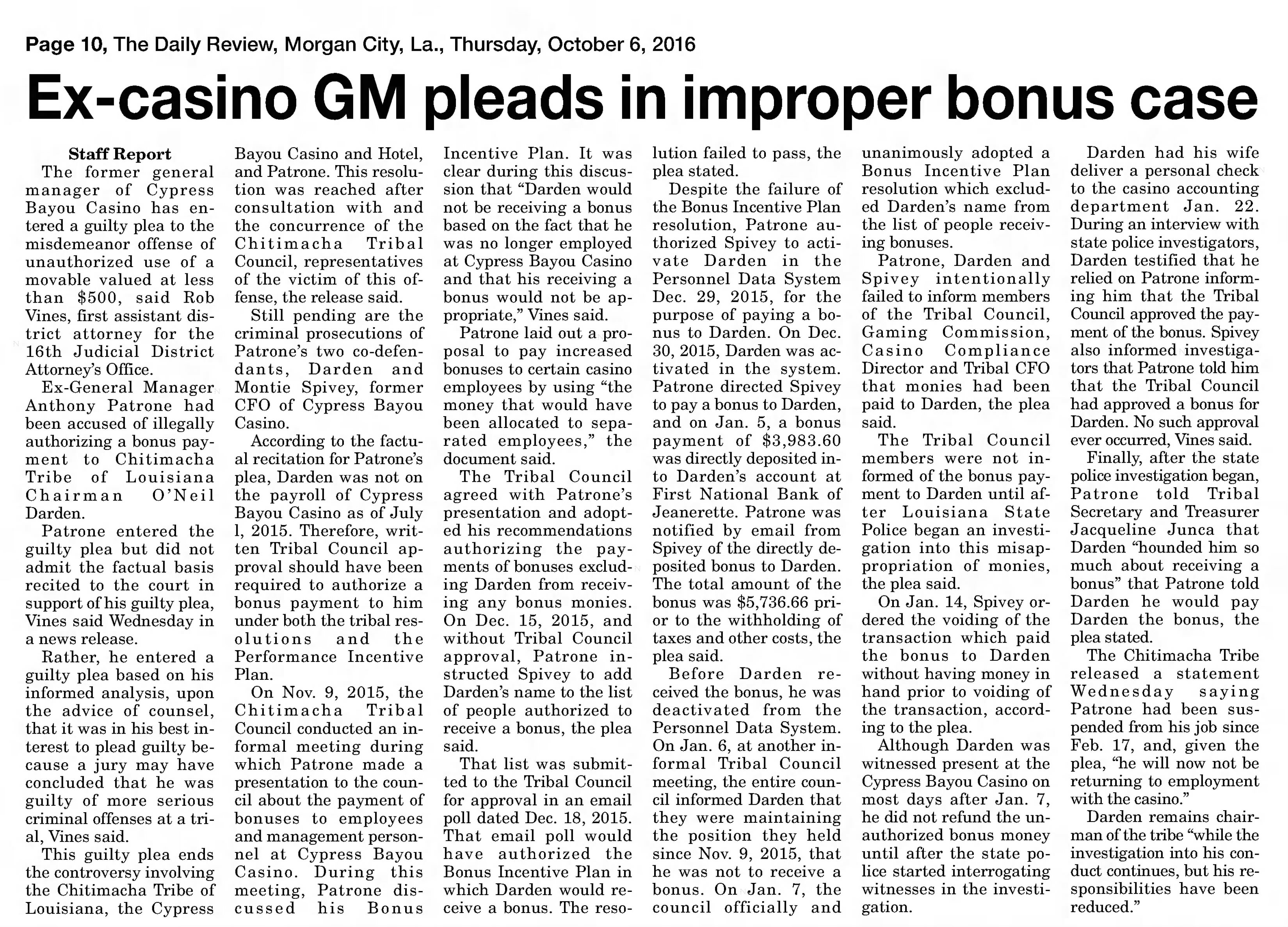
Here are the materials in Spivey v. Chitimacha Tribe of Louisiana (W.D. La.):

Yesterday, Justice Kagan asked about what bingo is:
There seems to be dispute whether this type of bingo by machine is the same as the bingo we know, people in a room calling out numbers.
p. 18, line 25 — p. 19, lines 1-3
In a colloquy with the tribe’s counsel, the Chief Justice also wondered aloud:
CHIEF JUSTICE ROBERTS: What would — what — what would you say it looks like?
p. 22, lines 4-25 — p. 23, lines 1-11
MR. MARTIN: I would say it looks like an electronic bingo machine that has a bingo —
CHIEF JUSTICE ROBERTS: What makes it look like a bingo machine?
(Laughter.)
MR. MARTIN: Well, there’s a — let me
CHIEF JUSTICE ROBERTS: There’s a name on it that says bingo?
MR. MARTIN: Well, there’s actually a card and you can switch the cards by pushing a button to change the cards that you’re playing. Now, are there reels and lights that look — that would characterize —
CHIEF JUSTICE ROBERTS: Are there people —
MR. MARTIN: — people would characterize it — yes.
CHIEF JUSTICE ROBERTS: — calling out numbers and — people, somebody saying, you know, B-12 or —
MR. MARTIN: There — there in fact is part of our operations, Your Honor. My tribe’s operations is live-called bingo and it’s also one of the things the State of Texas —
CHIEF JUSTICE ROBERTS: But that’s something different than the slot — slot machine bingo, right?
MR. MARTIN: It is different than the electronic machines, Your Honor, but they’ve complained about all of it.

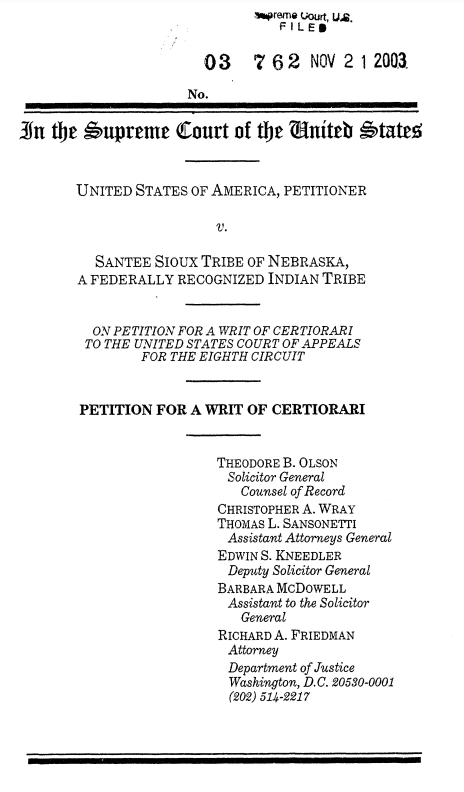
The law of these bingo slot machines has effectively been settled for nearly 20 years after the Supreme Court denied cert in a pair of petitions from the United States on this question (which later led to regulations that effectively codified the rulings from the courts below that the government lost):

What is Class II bingo, a Supreme Court Justice might ask? Well, the General Counsel for the National Indian Gaming Commission is there to offer answers:

Here are the updated materials in Kewadin Casinos Gaming Authority v. Draganchuk (W.D. Mich.):
Prior post here.
Law360 reports the state court held the tribe in contempt for failure to respond to discovery requests. Everyone’s got a litigation strategy, I guess. You can watch the hearing below.
Here are the materials so far in Kewadin Casinos Gaming Authority v. Draganchuk (W.D. Mich.):
1-6 State Court Motion for Contempt
1-7 State Court Hearing Transcript on Motion to Dismiss
1-8 State Court Motion to Compel
1-9 State Court Denying Summary Disposition for Kewadin
1-10 State Court Order Denying Motion to Dismiss by Kewadin
1-11 State Court Order re Discovery Motion
1-12 State Court Order to Show Cause
1-13 State Court Motion to Dismiss
1-14 State Court Response to Discovery Motion

Prior federal court suit here.
Last Friday’s D.C. Circuit opinion explains one of the many reasons the Lansing casino project died.
Here are the materials in Soloniewicz v. Sugar Factory LLC (Conn. S. Ct.):
Here are the materials in United States v. Nickey:
Unpublished opinion:
Briefs:
Here is the complaint in Maverick Gaming LLC v. United States (D.D.C.):
Anna Malinovskaya has posted “Understanding the Native American Tribal ‘Disenrollment Epidemic’: An IV Approach” on SSRN.
Here is the abstract:
Recently, over 80 Native American tribes have banned or disenrolled members of their tribes or denied citizenship to eligible individuals. This phenomenon has received media attention nationwide, and even the term the “disenrollment epidemic” was coined. Many speculate that at least some of it is driven by political struggles over multi-million dollar revenues of tribal casinos, which are sometimes distributed in per capita payments to all tribal members. In this paper, we test whether gaming has been driving disenrollments, and since a tribe’s involvement in gaming might be endogenous, we employ an instrumental variable approach. In particular, we use machine learning to select an optimal subset of instruments for a Native American tribe operating a casino from the set of potential instruments all plausibly meeting the exclusion restriction and associated with the geographical characteristics of reservations, such as their proximity to an MSA, an interstate highway, or a border of a neighboring state with no brick and mortar casinos. We find that a tribe’s involvement in gaming leads to a large and statistically significant increase in the probability of the tribe experiencing a disenrollment episode.
An excerpt:
This paper sought to understand if tribes’ involvement in the gaming industry, particularly wealth from per capita distribution of gaming revenues made possible by this involvement, has been the primary factor driving disenrollments and other types of dismemberment episodes. Both gaming and per capita distributions of gaming revenues are likely to be endogenous. Although we did not find an instrument for per capita distributions, we identified a set of instruments for gaming, and used them to understand, albeit indirectly, whether gaming has been driving disenrollments (the direct approach would be instrumenting for per capita distributions rather than gaming). Although this approach has its limitations
(as discussed in the Empirical Strategy section, it represents, to the best of our knowledge, the first attempt to identify a causal link between gaming and dismemberment in Indian tribes. Additionally, the consistency of results across our OLS and IV estimates, as well as across several sub-samples, is encouraging.
This research could be strengthened by instrumenting for per capita distribution of gaming revenues directly, though finding an appropriate instrument might be challenging. It could also be strengthened by finding instruments that would pass the Weak Instruments test for the full sample (327 tribes) that is likely to produce less biased IV estimates, or by using a different quasi-experimental empirical approach that would overcome the limitations associated with IVs when the sample is relatively small.
 Turtle Talk
You must be logged in to post a comment.