Here (PDF):
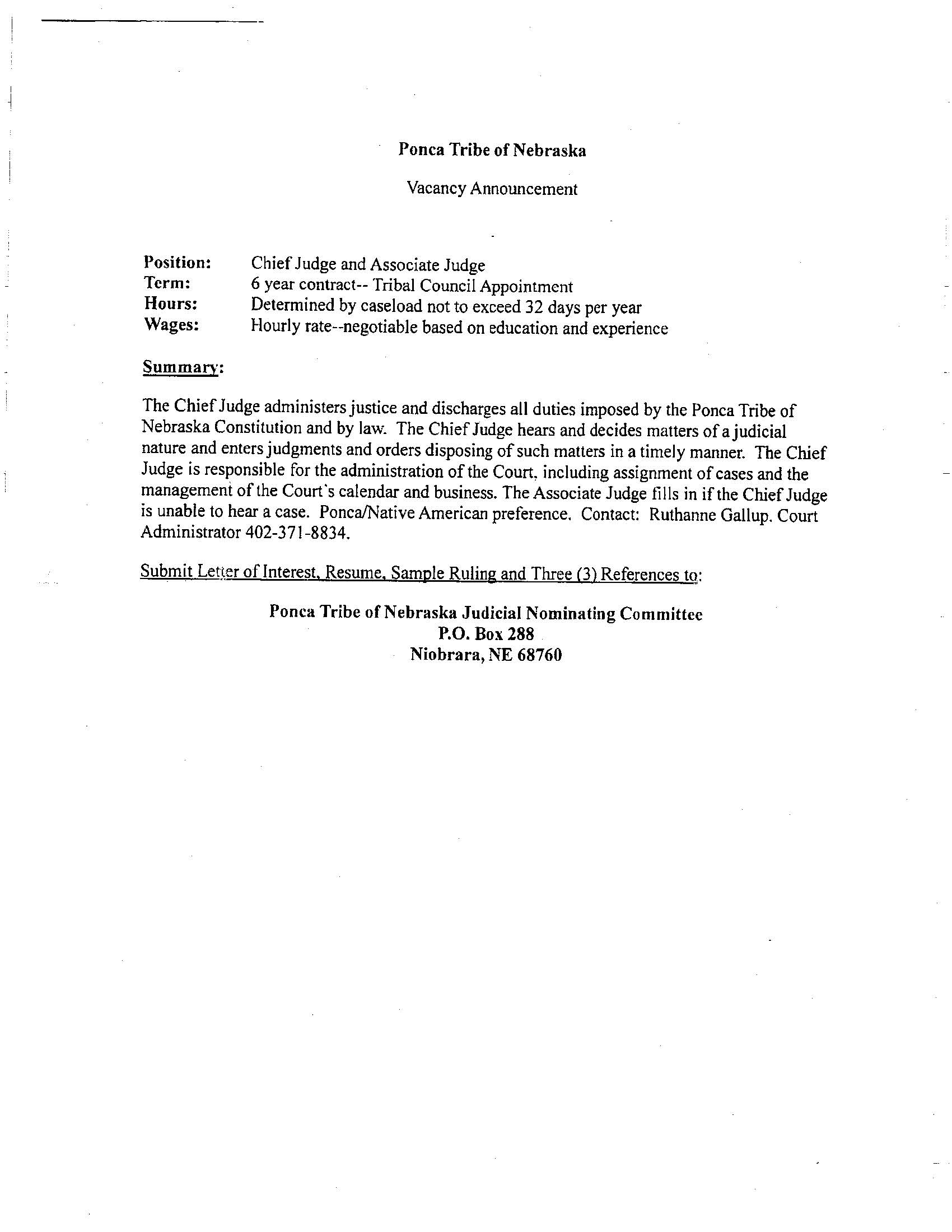
Ponca Tribe of Nebraska Seeking Trial and Appellate Judges
Here (PDF):
Here (PDF):
Here are the materials in Martin v. Quapaw Tribe (N.D. Okla.):
Here are the materials in Estate of Gopher:
An excerpt:
In its order, the Blackfeet Tribal Court unequivocally declined to assert subject matter jurisdiction with respect to the flag, the subject of this appeal. The Blackfeet Tribal Court noted that the “flag is located in Cascade County and has never been on the Blackfeet reservation” and Dorothy was domiciled in Cascade County at the time of her death. The Blackfeet Tribal Court stated it “will not accept any further filings from the Gopher family in regards to the thirteen star flag until they have prevailed in their litigation in the State Court.” No evidence supports the siblings’ argument that the Blackfeet Tribal Court’s decision was made “prematurely or through error.” Because the Blackfeet Tribal Court has expressly declined to assert jurisdiction over the Estate property, it is clear that the District Court did not unlawfully infringe on the Blackfeet Tribe’s right of tribal self-government. Moreover, because Dorothy resided in Cascade County at the time of her death and the corpus of the Estate is located in Cascade County, venue was proper, and the District Court did not err when it assumed jurisdiction over the probate of the Estate.
Here are the materials in St. Isidore Farm LLC v. Coeur D’Alene Tribe of Indians (D. Idaho):
3-1 St. Isadore Motion for TRO
21 Coeur d’Alene Motion to Dismiss
61 DCT Order Granting Motion to Dismiss
News coverage here.
Here are the materials in United States v. Bundy (D. N.M.):
US Motion to Introduce Evidence of Navajo Conviction
From the order:
As previously noted, Defendant has provided the Court with a copy of the transcript of her guilty plea proceeding. [Doc. 194-1] Since there is no indication in the transcript that Defendant was represented by counsel, the Court will not assume that Defendant was informed of her rights by counsel. Rule 12(c) of the Navajo Rules of Criminal Procedure required the judge, prior to accepting Defendant’s plea, to explain to Defendant that she had the rights (1) to remain silent, (2) to have counsel at her own expense or appointed counsel if defendant cannot afford counsel, (3) to plead not guilty, (4) to confront and cross-examine witnesses; (5) to be released on bail unless certain findings are made, (6) to trial by jury, (7) to a speedy and public trial, (8) to call witnesses, and (9) to file a writ of habeas corpus. Instead of the detailed enumeration of her trial rights contemplated by the Navajo Rules of Criminal Procedure, the page-and-a-half transcript shows a cursory, rudimentary colloquy. Although Defendant was asked “Do you understand your rights as explained to you?” the transcript does not include any enumeration of those rights, nor does the record show that Defendant was told that she was giving up those rights by pleading guilty. Under the Navajo Rules of Criminal Procedure, the advisement of rights pursuant to Rule 12(c) is the sole procedure for advising a defendant of her rights. Further, Defendant’s counsel has represented to the Court that an examination of the tape of the proceedings before the tribal court for April 22, 2009 fails to show any explanation of rights to Defendant or any other person. [Doc. 194 at 3, n.1] It appears that this prerequisite to a valid guilty plea was entirely overlooked in Defendant’s case. The Court finds that Defendant was not advised of key rights guaranteed by ICRA–the privilege against self-incrimination, the right to confront her accusers and to compulsory process, the right to counsel at her own expense, and the right to trial before a jury of not less than six persons. Section 1302 (4) (6) and (10). The transcript also shows that there was no inquiry into the factual basis of Defendant’s plea. Defendant has made a compelling showing that her guilty plea was not knowing and voluntary. Under ICRA due process of law is itself a right. Section 1302(8). The Court concludes that Defendant’s guilty plea was obtained in violation of the due process provision of ICRA, and under Shavanaux is inadmissible as substantive evidence in a subsequent federal prosecution.
In a footnote, the court added:
Given the solicitude of the Navajo Supreme Court for the rights of accused tribemembers, e.g. Eriacho v. Ramah District Court, 6 Am. Tribal Law 624 (Navajo Sup. Ct. 2005); Navajo Nation v. Curley, 6 Am. Tribal Law 697 (Navajo Sup. Ct. 2005); Curley v. Navajo Nation, 4 Am. Tribal Law 622 (Navajo Sup. Ct. 2002), the Court has considerable doubt whether a prior conviction based on a demonstrably invalid guilty plea would be admissible in Navajo tribal court over the defendant’s objection.
Here is the complaint in G2 v. Ponca Tribe of Indians of Oklahoma (W.D. Okla.):
An excerpt:
5. On March 1, 2010, the Ponca Tribe executed a “Construction Loan” in favor of G2 in the principal amount of $750,000.00, with a rider that all construction should be performed at cost plus 10%.
6. G2 performed all of its obligations under the Construction Loan contract.7. The Ponca Tribe had been substantially performing on this Construction Loan by making payments to G2 in the amount of $35,000.00 per month. See attached Exhibit 2.8. Despite G2’s notice of default and demand for repayment, the Ponca Tribe has defaulted on repayment pursuant to the terms of the Construction Loan. Said failure constitutes an event of default pursuant to the Construction Loan. The Ponca Tribe breached its contract with G2 by failing to make payments on the principal balance, and failing to otherwise cure the default.9. G2 has sustained damages in connection with the Ponca Tribe’s breach of contract.10. G2 has sustained damages and costs in connection with the Ponca Tribe’s continued use of its tax license, incurring fees and monies owed (OTC Case No. P-13-037-K).
11. G2 is entitled to recover damages it has sustained, including repayment of the remaining principal balance of $350,000.00, interest which continues to accrue, plus the expenses related to filing this action and reasonable attorneys’ fees.
Here.
An excerpt:
Because of the successful 2013 Reauthorization of the Violence Against Women Act, which President Obama signed into law on March 7, 2013, tribal courts and law enforcement will soon be able to exercise the sovereign power to investigate, prosecute, convict, and sentence those who commit acts of domestic violence or dating violence or violate certain protection orders in Indian country, regardless of the defendant’s Indian or non-Indian status. The tribal provisions of this landmark legislation were originally proposed by the Department of Justice in 2011 to address alarming rates of violence against native women. We believe today, as we did then, that this is not only constitutionally sound law, but it is also a moral prerogative and an essential tool to ensure that non-Indian men who assault Indian women are held accountable for their crimes.
You must be logged in to post a comment.